The AI-SDLC Maturity Program

Move your software teams up the AI maturity curve

AI tooling has become standard across engineering organizations. The first productivity gains appeared task by task. Attention then moved to the team: to collaboration between roles and to the output of the team as a whole. That is where progress has largely stopped. The decisive question is no longer whether individuals adopt AI, but how far a team travels beyond those first gains. Trivium installs a governed, AI-augmented way of building software, proven inside the engineering organizations of leading industrial enterprises. Your teams build that way of working live, on their own stack, and own it afterwards.

The AI Maturity Model

Most enterprises are positioned at Level 2

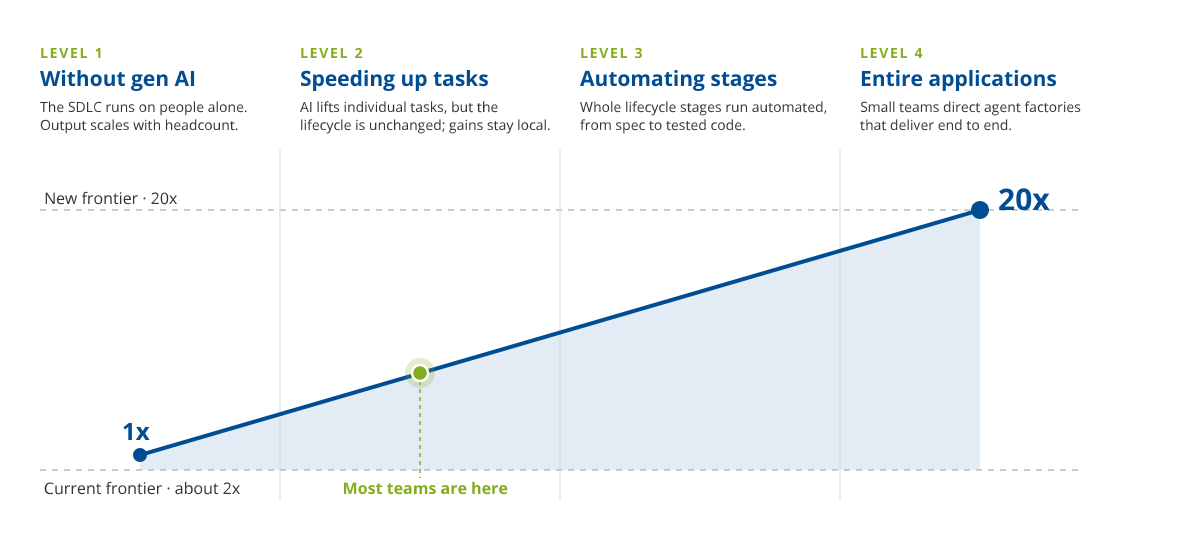
The impact of AI on software development can be read as a four-level maturity curve: Level 1 is output per developer without generative AI; Level 4 is a frontier many times higher. Level 2 is where AI assistants accelerate individual tasks while the way work moves through the lifecycle remains unchanged. The gains remain confined to individual roles and team silos, and they are hard to measure at the level of the delivery organization. Level 3 is where entire stages of the lifecycle run through AI reliably enough to trust the output - the level the second workshop targets.
The AI Maturity Model
Source: McKinsey, "The AI revolution in software development," April 2026 — excerpt from Rewired: How Leading Companies Win with Technology and AI, 2nd edition (Wiley, 2026). Redrawn by Trivium.

The Diagnosis

Why the plateau persists

No standard way of working

Every role works out its own way of using AI: its own prompts, its own quality bar, its own definition of “done”. The same task produces a different result depending on who picks it up, nothing is reusable across teams, and there is no baseline context to improve on.

Requirements no tool can read

AI delivers against the specification it is given. Where scope, acceptance criteria and architecture decisions stay implicit, or sit in documents no tool can reach, each role and each model fills the gaps differently and the result drifts from what was asked.

Standards without enforcement

A way of working that exists only as a guideline depends on discipline under delivery pressure. Without automated checks at merge, output volume rises faster than the capacity to review it, and quality becomes a function of who happened to look at it.

Our Approach

A standardized method, not just better prompts

Most AI training on the market concentrates on prompting technique. That raises the output of individuals, but it leaves the way work is specified, reviewed and released untouched, which is why organizations tend to remain at Level 2. The constraint is not the prompt but the process around it: how a requirement is written, what counts as done, and which checks a change has to pass before it ships. Standardize that process, make it readable by the tooling every role already uses, and enforce it automatically. The gains then compound across the team instead of accumulating in a few individuals. Trivium puts that standard in place first, and then enables teams to work inside it.

The AI-Augmented SDLC

One system for every role, one source of truth

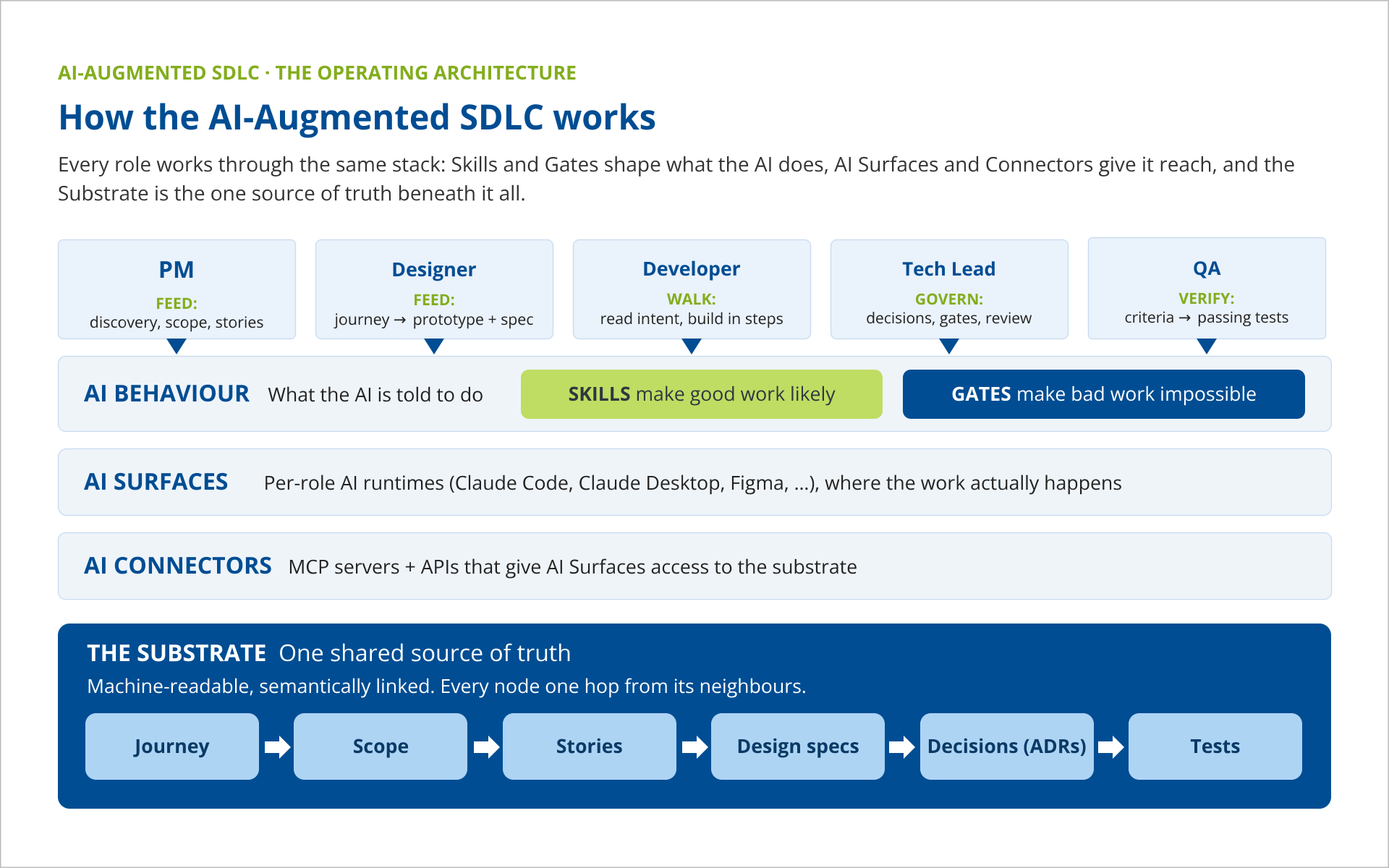
Getting there requires a shared operating architecture: built once, read by every role and every AI tool.

At its foundation lies the Substrate: a single, machine-readable and semantically linked source of truth. Every artifact the team produces becomes a connected node in one graph: problem statement, journey, scope, architecture decisions, stories, API contracts and tests. Intent moves out of individual heads and team repositories and into the work itself, where any AI tool can read it and contribute to it.
How the AI-Augmented SDLC works

Skills direct the work

Reusable instructions require every AI to consult the Substrate first, assembling the true intent behind a task before anything is produced. This makes good work likely.

Gates guarantee the outcome

Deterministic checks block the merge by default. Work that does not conform to the Substrate does not ship, irrespective of what the AI generated. This makes non-compliant work impossible.

Around this sits the individual discipline that every practitioner applies: context management, deliberate model selection, data hygiene, autonomy calibrated to risk and, above all, the habit of verifying everything. AI makes output likely to be correct. The practitioner makes it verified and accountable.


The Program

Maturity is the outcome. The workshops are the means.

The program consists of two hands-on workshops. Each starts from the way a team works today and takes it to the next level. They are distinct programs, each tailored to a level of the maturity model, and a team enters where it actually stands.

Ctrl + Alt + AI

Level 1 → Level 2 · One day · The individual craft
A hands-on day that takes a team from ad-hoc prompting to disciplined agentic development. Participants learn how AI agents work, where they fail and how to place guardrails around them, and then build a real slice of software end to end with an agent: spec-first, test-driven, reviewed and shipped through a green pull request. Each participant writes their own reusable Skill and their own enforcing gate, so the discipline lives in the repository rather than in memory.

AI-Augmented SDLC

Level 2 → Level 3 · Three days · The team system
Over three days Trivium demonstrates the AI-Augmented SDLC in full: the Substrate, the Skills and Gates that govern how AI is used, and the Connectors that give each role’s tooling access to it. The team then runs a working sprint on its own backlog, standing up those layers and refining the process until it holds. The team leaves with a running, higher-maturity SDLC on its own stack, proven in a hands-on sprint rather than on slides. It also takes away a template repository, prompt packs and role playbooks to clone, plus a defined path to promote the method across the organization.


Differentiators

What sets this program apart

A standardized process, enforced

We standardize how work is specified, built and released, and enforce it in the pipeline, rather than improving the technique of individual users.

Tool-independent by design

Because the Substrate is the contract, tools such as Claude Code, Figma and Cursor can be swapped out without re-engineering teams or processes, and so can whatever replaces them. We teach the architecture; you apply it to the tools you already run.

Individual craft and team system

The method covers both the individual and the organization, across product, design, engineering, tech leadership and QA, and it promotes cleanly from a single team to the enterprise.

Guarantees, not intentions

Gates ensure that “done” means proven, enforced automatically rather than asserted.


The Evidence

Proven where it matters most: in production

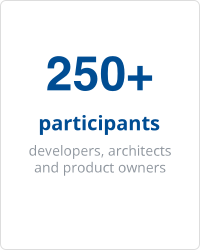
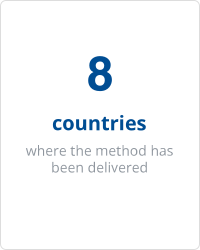
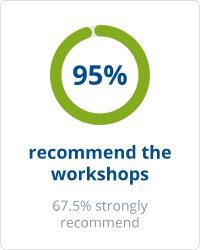
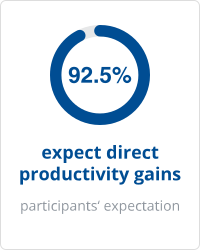
This method was built alongside, and proven inside, the engineering organizations of leading industrial enterprises, and refined in practice by Trivium's own architects and developers in demanding production environments. To date, more than 250 developers, architects and product owners across eight countries have been through it.
Selected customers

quote

"The biggest takeaway? It’s not just about learning tools, it’s about changing the way we think and build."

Department Lead, Engineering & Agile Leadership

Global energy technology company

Who It Is For

For leaders responsible for more than one team

The Decision Maker

The program is designed for the executive accountable for AI adoption across more than one team: the VP of Engineering, Head of Development, CTO or transformation lead who needs one governed operating model rather than a dozen private ones.

The Participants

The participants are complete delivery teams: product managers, designers, engineers, tech leads and QA. Both workshops are hands-on and taught by role, so every function leaves knowing precisely how its own work changes.

The Horizon

A foundation for what comes next

The organizational curve continues beyond the program. Level 4, delivering entire applications through agent factories, is the frontier, and a higher-maturity foundation is what makes it reachable. Where an organization chooses to scale the method, or to accelerate the delivery it unlocks, Trivium can provide the teams and consulting services to do so.

Find out where your teams stand on the maturity curve.